North Carolina Beneficiary and Executor Deed
County Specific Legal Forms Validated as recently as October 21, 2026 by our Forms Development Team
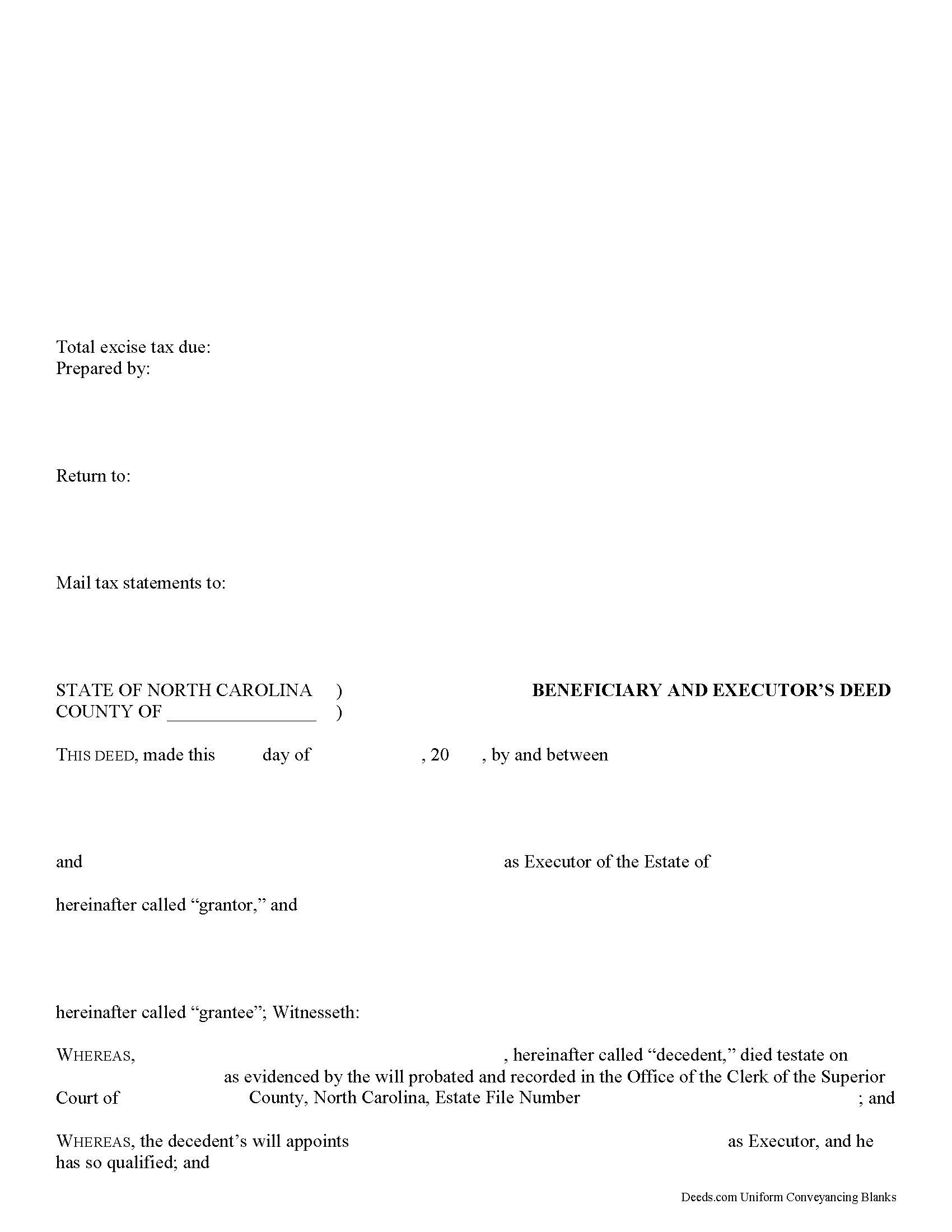
About the North Carolina Beneficiary and Executor Deed
How to Use This Form
- Select your county from the list
- Download the county-specific form
- Fill in the required information
- Have the document notarized if required
- Record with your county recorder's office
What Others Like You Are Saying
"Quick service!"
"I don't pay very close attention to what I'm doing all the time which leads to mistakes. Deeds.com w…"
"Satisfied with downloaded documents."
"Great site. quick turnaround and communication. I needed an exception that they told me I needed and…"
"Brilliant idea. Beats working with an attorney who charges $250+ per hour. Thanks."
4.8/5 from 4,836 reviews. Read all
North Carolina handles a decedent's real estate in a way that catches many families off guard: the land never sits in the estate. The moment an owner dies leaving a probated will, title vests in the devisees named in that will. A Beneficiary and Executor Deed is built around that fact. The people who inherited the property sign as the grantors who convey it, and the executor signs alongside them to consent to the sale and to make the conveyance hold up against the estate's creditors while the estate is open.
Why the Devisees Sign and the Executor Joins
Under N.C. Gen. Stat. 28A-15-2(b), title to a decedent's real property vests in the heirs at death, and where there is a probated will it vests in the devisees and relates back to the death. Because the devisees hold legal title, they are the grantors. The executor's signature does different work: N.C. Gen. Stat. 28A-17-12 provides that, where the notice to creditors is first published within two years after death, a sale by the devisees before the final account is approved is void as to creditors and the personal representative unless the personal representative joins. The executor's joinder binds the estate and its creditors during the open-estate window.
A Deed for a Testate Estate
This is the testate form: the decedent left a will, an executor qualified, and the estate is still open. The deed recites the date of death, the county of probate, and the estate file number, states that the executor was appointed under the will and is duly qualified and that notice to creditors has been given, and identifies the source of the executor's authority to consent to the sale. Where the will gives a general power to sell, N.C. Gen. Stat. 28A-15-1(c) lets the sale proceed without a separate Article 17 court proceeding. The intestate counterpart, in which an administrator joins the heirs, is the separate North Carolina Beneficiary and Administrator Deed.
Warranty That Fits a Fiduciary Sale
Because the devisees own the property, they can warrant title, and this deed has them give a limited warranty: they covenant that they placed no lien or encumbrance on the property and will defend against claims by, through, or under themselves or the decedent's estate, but no further. The executor joins without any warranty of title. North Carolina supplies no statutory short-form deed and reads covenant scope from the deed's own words, construed for the intent of the whole instrument under N.C. Gen. Stat. 39-1.1.
Marriage, Signing, and Recording
A married devisee-grantor's spouse joins in the deed. N.C. Gen. Stat. 39-7 contemplates spousal execution to waive the elective life estate that N.C. Gen. Stat. 29-30 gives a surviving spouse, so the form carries a joinder line for each married devisee-grantor's spouse. It provides blocks for up to two devisee-grantors plus the executor; additional devisees continue on an attached exhibit. Each signer acknowledges before a notary on a separate certificate, since registration is effective only as to parties whose execution is acknowledged. The deed is recorded with the register of deeds where the property lies; because North Carolina registers in order under N.C. Gen. Stat. 47-18, prompt recording protects priority, and the State excise tax is collected before recording.
The package includes the blank deed as a fillable PDF, a plain-language guide that walks through every section and the governing statutes, and a completed example built on a realistic Wake County sale. The materials are informational and are not legal advice; many estate sales in North Carolina are handled with the assistance of counsel.
Important: County-Specific Forms
Our beneficiary and executor deed forms are specifically formatted for each of the 100 counties in North Carolina.
After selecting your county, you'll receive forms that meet all local recording requirements, ensuring your documents will be accepted without delays or rejection fees.