Iowa Certificate of Trust
County Specific Legal Forms Validated as recently as October 14, 2026 by our Forms Development Team
About the Iowa Certificate of Trust
How to Use This Form
- Select your county from the list
- Download the county-specific form
- Fill in the required information
- Have the document notarized if required
- Record with your county recorder's office
What Others Like You Are Saying
"I would definitely recommend Deeds.com. It was so easy! I wish we knew about them a long time ago."
"So far everything is going really well. Thank you!"
"Happy with your service. Everything as advertised."
"1) I was very pleased when the staff mentioned your service since the three referenced on the Record…"
"Great job with these forms. Super easy and up to date, a rare find online these days. Thank you."
4.8/5 from 4,836 reviews. Read all
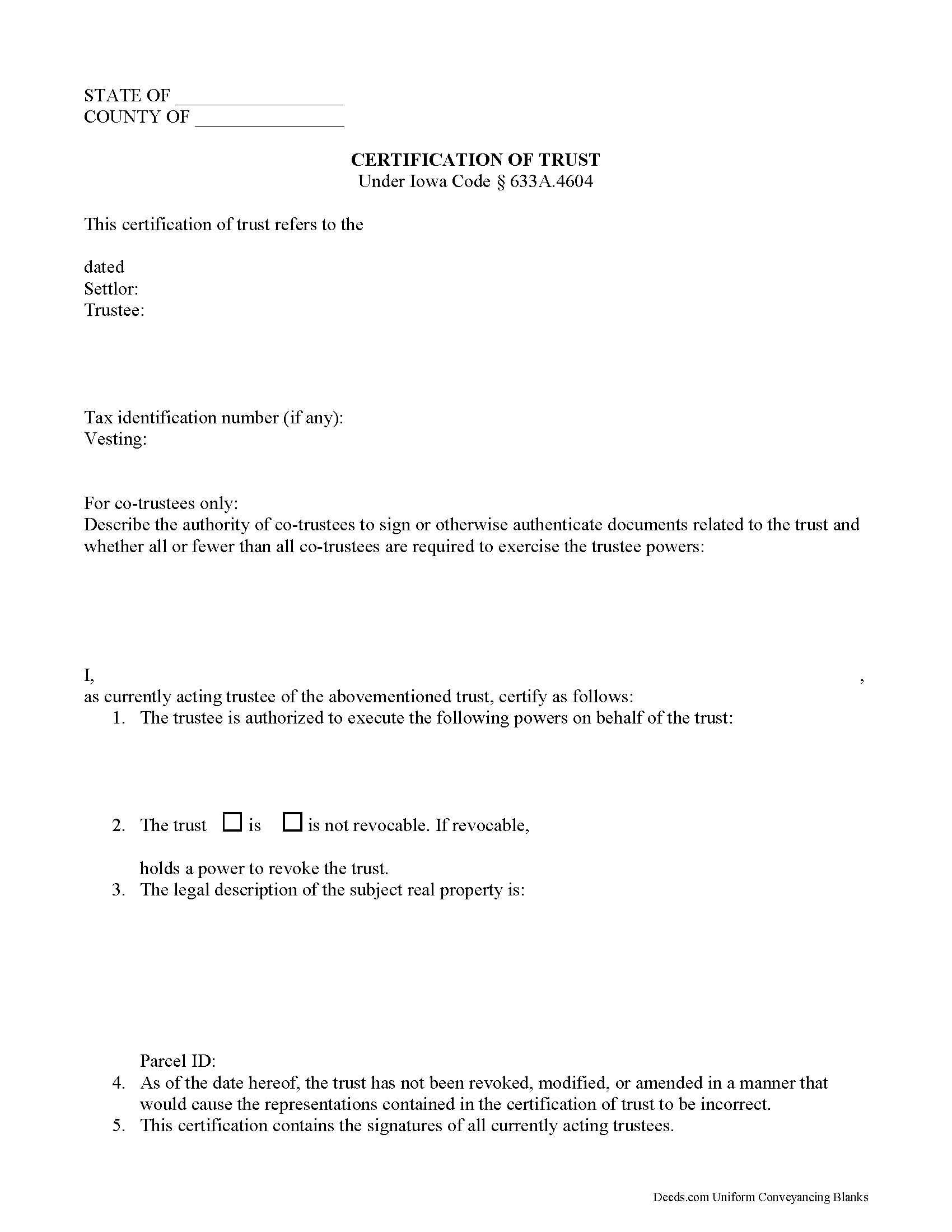
Under Iowa Code 633A.4604, the certification of trust is an official document confirming the terms of a trust as they relate to a specific transaction. Trustees wishing to enter into a transaction in the trust's name may be asked to present a certification of trust to prove the trust's existence and the trustee's authority to enter into the transaction.
A certificate of trust presents the name and date of the trust under which the trustee is acting, as well as the identities of the trust's settlor and trustees. The document provides the name by which the trust will hold title to trust assets, and includes the trust's taxpayer identification number (TIN).
If there is more than one trustee, the certificate identifies who has authority to sign documents relating to the trust and how many co-trustees are required to sign. The document also enumerates the trustee's powers relative to the transaction at hand, and includes the name of any person able to revoke the trust, if applicable. Like other documents affecting real property, the certificate should include the legal description of the subject property.
Finally, the certificate requires statements that the trust has not been revoked, modified, or amended in any manner to cause the representations contained within to be incorrect; that the document is being signed by all acting trustees; and that the certificate is sworn and subscribed to under penalty of perjury before a notary public (Iowa Code 633A.4604(2)).
The statements contained within the certificate may be relied on as if they were fact, but recipients of a certification of trust may request copies of the sections of the trust instrument designating the trustee and conferring the trustee's powers pursuant to Iowa Code 633A.4604(4). A recipient requesting the entire trust document may be liable for damages if a court finds they acted unreasonably in their request (Iowa Code 633A.4604(6)).
Consult a lawyer with questions regarding trust law and certifications of trust, as each situation is unique.
(Iowa Certificate of Trust Package includes form, guidelines, and completed example)
Important: County-Specific Forms
Our certificate of trust forms are specifically formatted for each of the 99 counties in Iowa.
After selecting your county, you'll receive forms that meet all local recording requirements, ensuring your documents will be accepted without delays or rejection fees.